Surviving the chaos of constant cyberattacks: a map for the office and for developers
Microsoft 365, TikTok, GitHub and US flights all went down within two weeks, yet most of those events were not attacks. Where the real risk sits, and six habits that reduce it.
Between November 10 and 25, email stopped for a day at Microsoft, every US flight was grounded, a major bank’s transactions stalled, TikTok went blank and GitHub slowed to a crawl. The Independent ran a numbered list of the outages and reported growing fears that cyberattacks were behind them.
We picked nine prominent events from those two weeks and checked what the companies and researchers said about each. The list is not exhaustive; there were other outages and breaches in the same period. Incident status and company reports were checked on November 26. The result is less frightening than the headlines and more useful, because it points to a short list of actions: one for people who simply work at a computer, and one for people who write and ship code.
Most of the loud events were not attacks
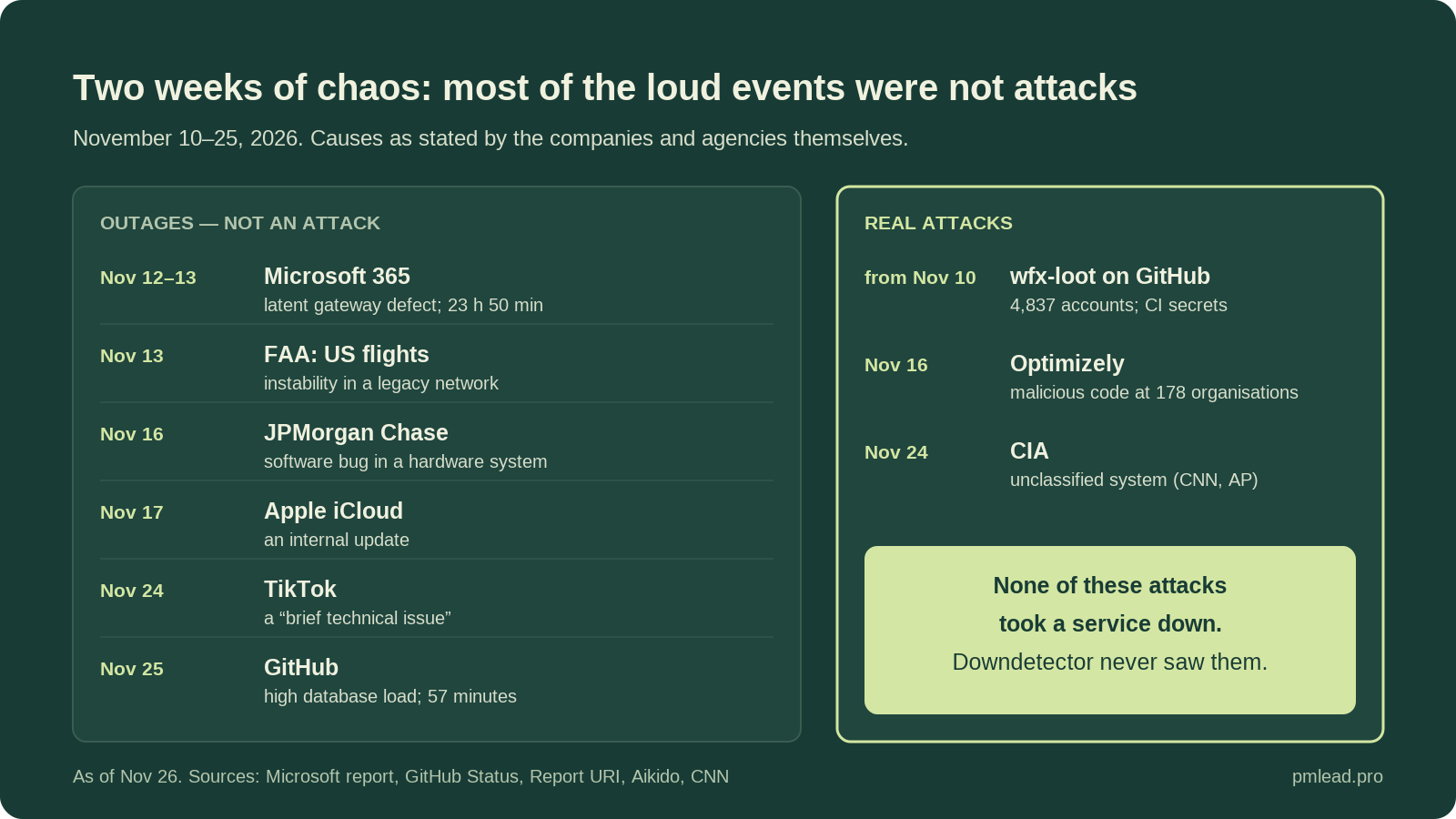
Six of the nine were explained by the organisations as their own failures:
- Microsoft 365, November 12–13. Exchange Online mail was unavailable to most users for 23 hours and 50 minutes; Teams and Copilot were also affected. Microsoft’s final post-incident report attributes the outage to four factors coinciding: a latent defect in a network-gateway update rolled out since July, reduced server capacity, a Teams traffic failover, and the daily load peak. At the worst point more than 80% of servers were unresponsive. The company confirms it was not a cyberattack (Microsoft report MO1550821, November 20, 2026; a copy, the original is available to Microsoft 365 administrators).
- FAA, November 13. The agency attributed the nationwide ground stop to instability in its legacy network (Interesting Engineering, November 24, 2026).
- JPMorgan Chase, November 16. The bank reported a software bug in an on-premise hardware system and said it was not cyber-related (The Independent, November 24, 2026).
- Apple iCloud, November 17. Apple said an internal update caused the disruption (same source).
- TikTok, November 24. The company called the problem a “brief technical issue” (The Verge, November 24, 2026). We found no fuller explanation of the cause as of November 26.
- GitHub, November 25. The incident lasted 57 minutes, from 15:55 to 16:52 UTC. GitHub attributed the failures to high database load and promised a detailed root cause analysis, which had not appeared as of November 26 (GitHub Status, November 25, 2026).
These are the organisations’ own statements, and we have not verified them independently. The line between an outage and hostile activity is not always clean: later on November 25, GitHub’s large-file storage was partly degraded for three hours, and the company cited a large volume of automated, unauthenticated traffic without calling it an attack (GitHub Status, November 26, 2026).
In the same two weeks there were also three confirmed attacks, and none of them took a service offline:
- Since November 10, an attacker has used 4,837 stolen developer accounts to open probe pull requests in 61,764 GitHub repositories and push code that steals build secrets. Signs that the code ran were found in at least 1,806 repositories, where the run logs had been deleted (Aikido, November 12, 2026).
- On November 16, malicious JavaScript was served through the Optimizely platform to visitors of 178 organisations, including the BBC, CNN and Zoom (Report URI, November 16, 2026). Optimizely confirmed the incident: the attacker exploited a flaw in account signup to impersonate customers’ users, fewer than 5% of customers were affected, and the vulnerability was closed within three hours of detection (Optimizely, updated November 19, 2026).
- On November 24, a breach became public of an unclassified system that the CIA and the Office of the Director of National Intelligence use for open-source intelligence analysis. An ODNI official said classified systems were not affected (CNN, November 24, 2026, citing four sources; AP, November 24, 2026).
That gives the first practical conclusion. What everyone can see is usually an outage. What steals money and access works quietly, and it surfaces in researchers’ reports rather than on Downdetector.
If you simply work at a computer
A TikTok or email outage does an office worker no harm by itself. The risk arrives when someone offers a quick fix while the service is down.
TikTok supplies its own example. Researchers have described videos posing as free activation guides for Windows, Spotify or Netflix. The viewer is told to open PowerShell as an administrator and paste a single line, which downloads a program that steals passwords and sessions from the browser (BleepingComputer, October 19, 2025). The person infects their own machine, which makes the attack harder for security software to stop.
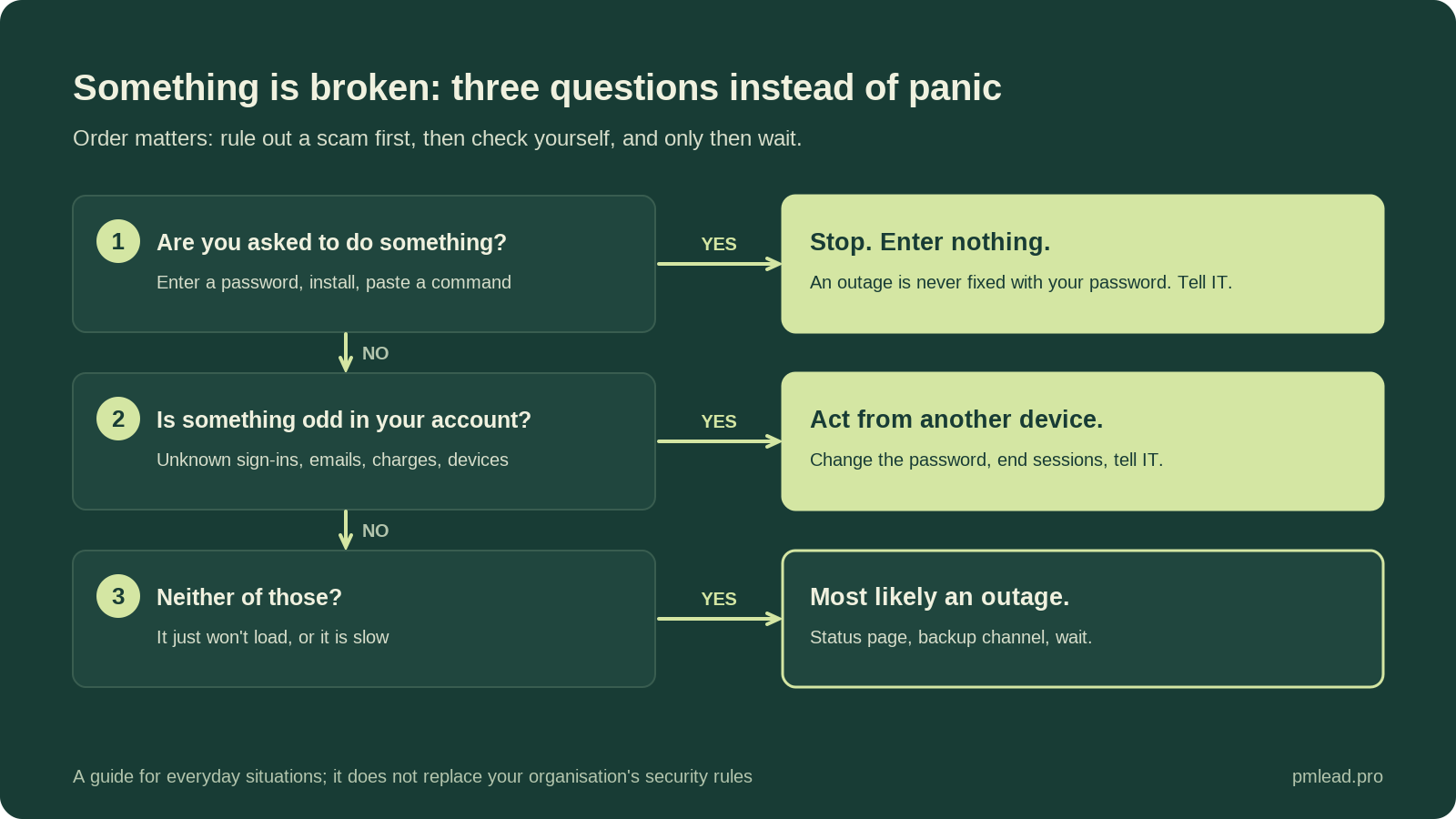
When something stops working, ask three questions in this order:
- Am I being asked to do something? Enter a password “to restore access”, install a “fix”, paste a command. If so, stop. A real outage is repaired by the service owner, who does not need your password to do it.
- Is anything odd in my account? A sign-in from an unfamiliar place, emails you did not send, charges. If so, use a different device to change the password, end all sessions, and tell your IT support.
- Neither? It is most likely an outage. Open the service’s official status page, switch to your backup channel, and wait.
Three habits are worth setting up before the next outage: a password manager with a separate password for every service, passkeys or an authenticator app instead of SMS codes, and a bookmark for signing in to important services instead of a link from an email. These are our recommendations, not the result of our own measurement.
If you write and ship code
In each of November’s attacks the victim did not make a careless mistake. The victim trusted someone else: a third-party script, a colleague’s account, an image from a registry, a take-home test.
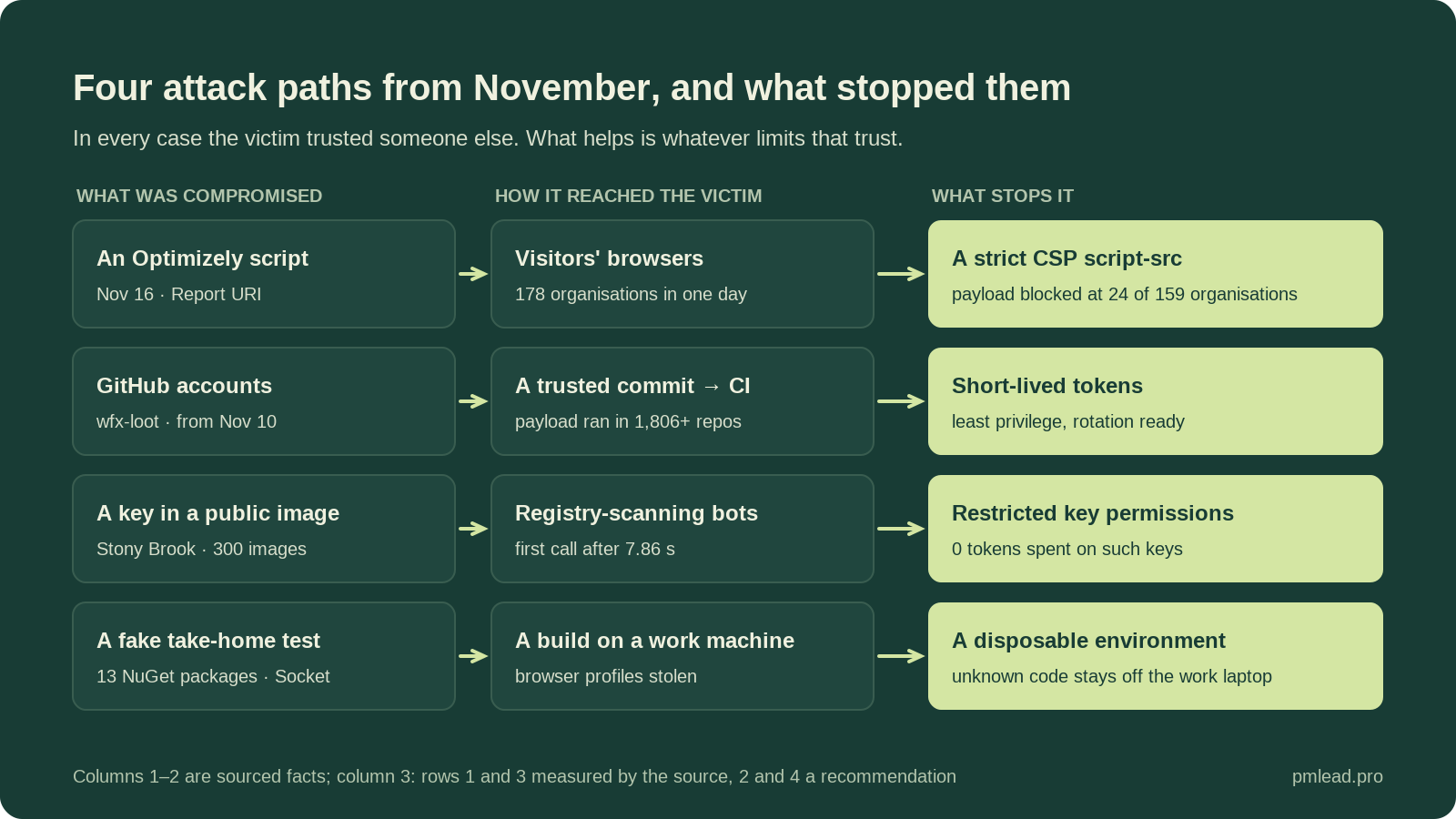
A third-party script on your site. In the Optimizely case the malicious code came from the trusted domain, so allowing that domain in a security policy achieved nothing. Report URI classified the Content Security Policy of 159 affected organisations: 68 had none, 50 allowed both the payload and the data theft, 17 stopped only part of it, and just 24, or 15%, blocked the payload entirely. What set those apart was a strict script-src that listed only the hosts the site needed.
An account with write access. In the wfx-loot campaign the commit arrives under a real developer’s name, the change is then reverted, and the workflow run and its logs are deleted. Endor Labs (November 12, 2026) advises treating everything the pipeline could reach as compromised if a malicious commit landed. For a team, that means having a secret-rotation procedure written before the incident, not during it.
A key in a public image. Over four months, researchers at Stony Brook University published 300 decoy images across eight public registries, holding AWS, OpenAI and Claude keys. The keys were exploited as quickly as 8 seconds after publication, and the OpenAI and Claude balances were drained completely (“Gone in 8 Seconds”, the study’s page, November 14, 2026). The fastest AWS call came after 7.86 seconds, and the median was 51 seconds (BleepingComputer, November 17, 2026). Yet no key with restricted permissions was used to consume tokens (Help Net Security, November 25, 2026). We have not read the full paper: the first figures come from the authors’ abstract and the rest from two reports of it. Noticing and revoking quickly cannot win that race. Only what was set up beforehand helps: least privilege and short lifetimes.
A take-home test. Socket found 13 malicious NuGet packages linked to fake job assessments for .NET developers. Building or running the project downloads files from GitHub, and the campaign’s payloads include a Chrome profile stealer (Socket, November 23, 2026). Unfamiliar code belongs in a disposable environment, not on a work laptop.
When the incident is yours
The most candid account of what chaos looks like from the inside came from Microsoft’s internal documents. After the outage the company declared an internal “Code Red”. According to internal memos first reported by Reuters (November 24, 2026), engineers sent more than 11,000 messages across 11 Teams chats during the outage, diagnostic data sat in separate systems, and no shared picture existed. We have seen neither the memos nor the full Reuters text; the figures are as relayed by The Next Web (November 24, 2026).
This applies well below Microsoft’s scale. A team of five also needs three things agreed in advance: one place to discuss the incident, one log of decisions, and one person who coordinates and does not fix.
A map for the wall
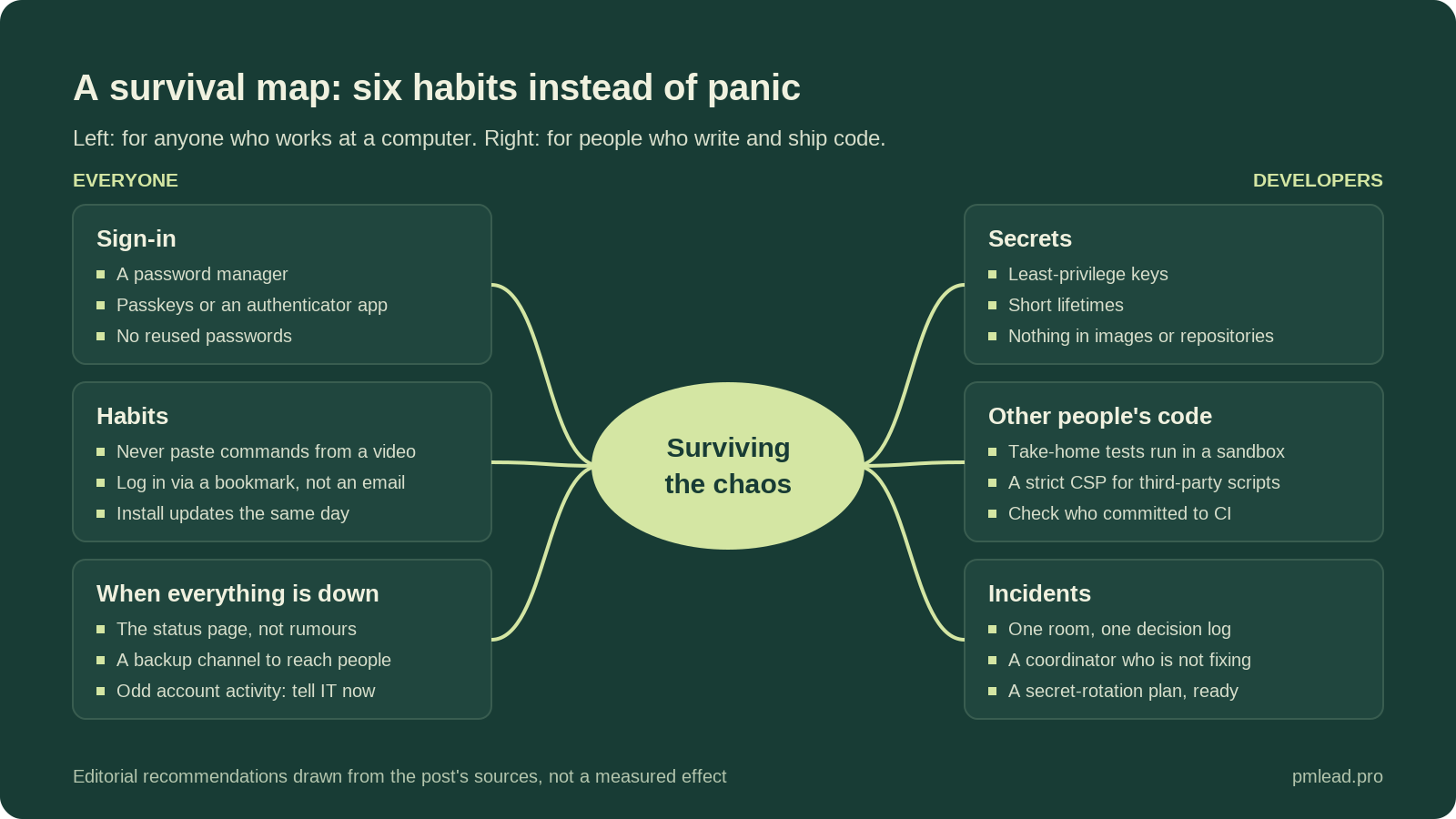
The six branches of this map will not stop every attack. They separate noise from real risk, and they limit the damage when an attack does succeed. If you start with one item today, make it a review of key permissions and lifetimes for developers, and a password manager for everyone else.
Sources: The Independent (November 24, 2026) · Interesting Engineering (November 24, 2026) · The Next Web (November 24, 2026) · GitHub Status (November 25, 2026) · AP (November 24, 2026) · Report URI (November 16, 2026) · Endor Labs (November 12, 2026) · Help Net Security (November 25, 2026) · Stony Brook, “Gone in 8 Seconds” (November 14, 2026) · BleepingComputer (November 17, 2026) · Socket (November 23, 2026) · Reuters (November 24, 2026) · BleepingComputer (October 19, 2025) · Microsoft, post-incident report MO1550821 (November 20, 2026) · Optimizely (updated November 19, 2026) · Aikido (November 12, 2026) · CNN (November 24, 2026) · The Verge (November 24, 2026)